Across Southwest Virginia, tucked behind tree lines and down gravel roads, stand the quiet giants of another era. They don’t make much noise anymore. Their wheels have stopped turning, their millraces have dried, and their timbers have silvered into the color of old bone. But for most of the 19th century, these mills were the beating heart of every valley and crossroads community from Wythe to Carroll to Pulaski.
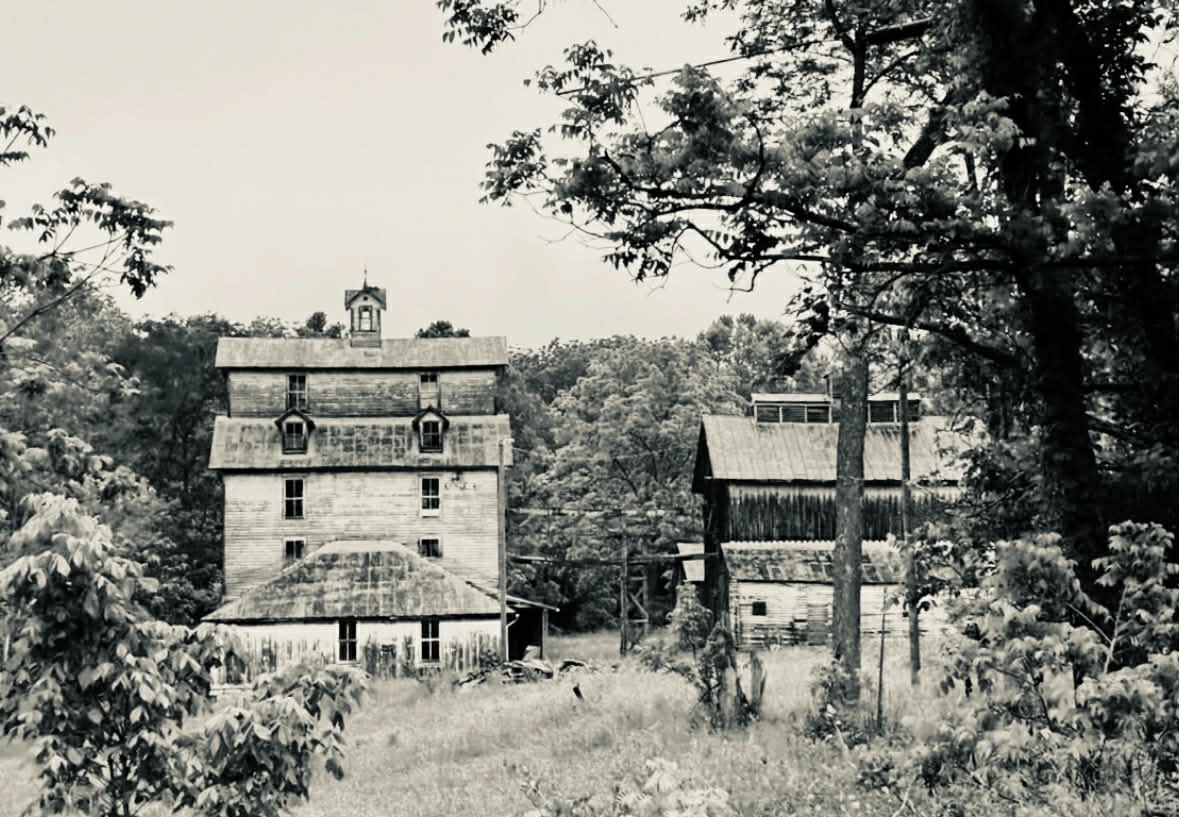
One of the most striking survivors is the towering old mill at Graham’s Forge in Wythe County — the one rising out of the brush along Reed Creek like an apparition from 1890. Most people never see it unless they know exactly where to look, and even then it feels half-hidden, as if the land is keeping it for itself. It’s on private property and not accessible to visitors, but its profile alone tells the story: five stories tall, crowned with a small cupola, and framed in the kind of Victorian bracing that made utilitarian buildings look almost proud.
That same story repeats itself across the region. Every community once had a mill — sometimes several — and each one was a lifeline. A place where wheat became flour, corn became meal, logs became boards, and water became power. Before electricity, the streams of Southwest Virginia were the engines of daily life. Reed Creek, Cripple Creek, Walker Creek, the New River, Little Reed Island Creek — all of them hosted mills whose wheels churned out the necessities that kept families fed and towns growing.
In the 1800s, a mill wasn’t just a building. It was the unofficial town square. Farmers hauling grain would linger to trade news, pick up mail, sharpen tools, settle accounts, and, occasionally, settle arguments. Kids would fish downstream from the raceway. Travelers would stop for directions. The miller knew everyone, and everyone knew the miller.
Some of these buildings still stand today, even if they lean a little harder each winter. The Reed Creek Mill in Wytheville — still lovingly maintained — shows what a restored mill can look like when a community decides the past is worth protecting. The mill at Fincastle in Botetourt County, the remnants of the Pulaski County mills, and the old structures scattered across Carroll and Grayson County all echo the same story: industry built at a human scale, run by water, sweat, and neighborly interdependence.
Others, like the one at Graham’s Forge, remain untouched, aging quietly on private land. They’re relics of engineering that mixed local timber, hand-hewn beams, and mechanical ingenuity. Even in disrepair, they wear their history plainly — cracked windows, rusted metal fittings, and weathered siding that’s somehow endured more than a century of storms.
What they offer us today isn’t production or profit. It’s perspective. These mills remind us how Southwest Virginia once operated before highways and supermarkets, when entire communities depended on a single stream of water and a good millstone.
They’re pieces of our landscape, pieces of our identity, and pieces of our story. And as long as they stand — in full operation or tucked out of sight in the woods — they continue to whisper a truth about Southwest Virginia:
We have always been a region built by hand, powered by the land, and held together by communities that showed up for one another.
And somewhere along a back road, past a bend in the creek, you can still see that history towering over the trees.