By: Jeremy Farley
For as far back as I can remember, Rural Retreat, Virginia, has always claimed Dr Pepper as its own. If you grew up anywhere in Wythe County, you probably don’t remember a time before the town embraced the story.
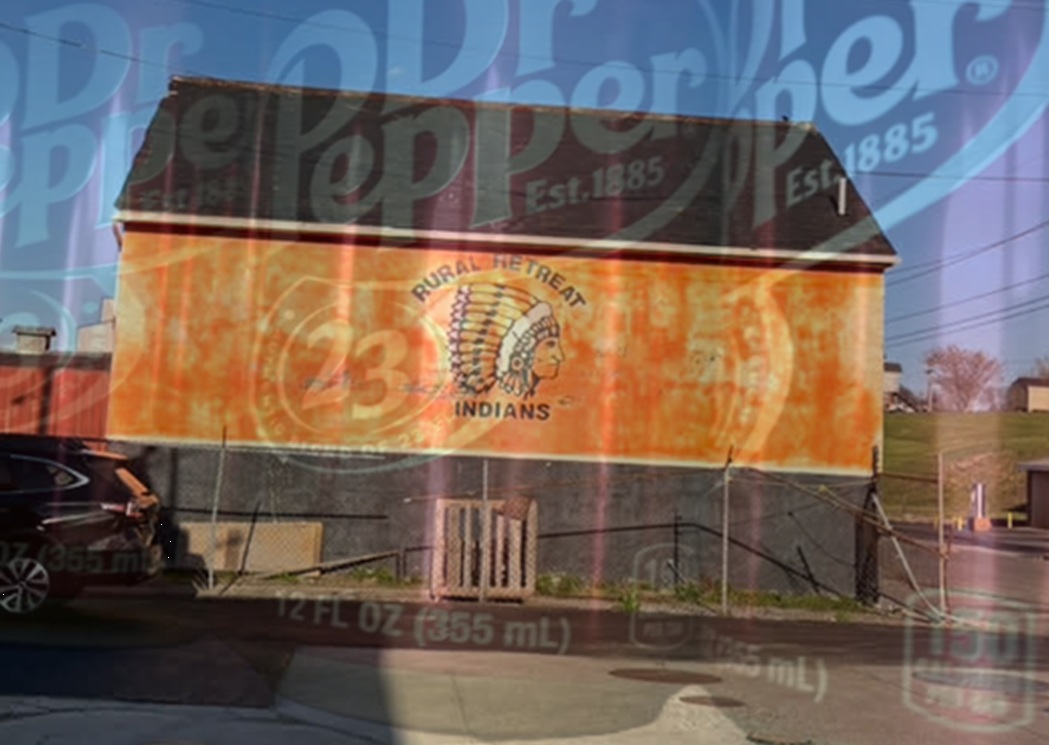
There once was a Dr Pepper logo proudly on the side of a building. There are local events that nod toward the legend. And years ago, a well-executed April Fool’s joke even claimed the town was repainting its famous twin orange water towers to look like a pair of Dr Pepper cans.
And of course, up on the hill at Mountain View Cemetery, there’s the unmistakable marble obelisk in honor of a man the tombstone calls “Pepper” — the real, living, breathing physician who practiced here more than a century ago.
With all that, the conclusion seemed obvious: Rural Retreat was the home of Dr Pepper. Case closed.
At least, that’s what I believed… right up until I visited the official Dr Pepper Museum in Waco, Texas. I walked through the exhibits expecting a section on Virginia’s Dr. Charles Taylor Pepper, maybe a photograph of Mountain View Cemetery, maybe even a nod to the old stories we’ve always told back home.
But there wasn’t a single reference to Virginia. Not one.
That sent me down a rabbit hole — hours of reading, digging, cross-checking, and trying to figure out how our local legend fit with the official narrative told in Texas. As it turns out, the true history of Dr Pepper is far messier, far murkier, and far more interesting than any single town — Rural Retreat or Waco — can claim all by itself.
And before I go any further, let me say this clearly: No one loves small-town pride more than I do, and Rural Retreat folks are some of the best you’ll ever meet. My goal here isn’t to burst anybody’s bubble — just to lay out the story the way the evidence gives it. And from there, we can choose our own beliefs.
So let’s take it slow and stick to what we can truly know.
What We Know for Sure
Dr Pepper the drink was invented in Texas.
In 1885 — a year before Coca-Cola — a young pharmacist named Charles Alderton began mixing syrups at Morrison’s Old Corner Drug Store in Waco. The combination of 23 flavors became a hit with customers, who first ordered it under the nickname “Waco.” It wasn’t long before the drink spread across Texas.
Later, store owner Wade Morrison began selling it more widely — and somewhere along the way, he changed the name to Dr. Pepper.
This part of the story is well-documented. The Waco museum leans heavily on it, and rightly so.
Rural Retreat’s Dr. Pepper was a very real person.
Long before the soda existed, Dr. Charles Taylor Pepper (1830–1903) was practicing medicine right here in Wythe County. Born locally, trained at the University of Virginia, and a Confederate surgeon during the Civil War, Dr. Pepper returned home after the conflict to run a medical practice and operate a drug store in Rural Retreat.
He sold patent medicines.
He mixed fountain drinks.
He was exactly the kind of 19th-century doctor whose name sounds like a soda.
And his grave — with a tall headstone — still stands over the town.
Those are the solid facts.
Everything beyond this point?
Well… it’s where the story gets delightfully cloudy.
Where the Story Turns Gray
Why did Wade Morrison name the drink “Dr Pepper”? This is the ultimate question that is nearly impossible to answer factually. No one knows for certain, and anyone who insists they do is selling either folklore or pride.
There are three main theories:
Theory #1 — Named after Dr. Charles T. Pepper of Rural Retreat
This is the story most of us here grew up believing.
The legend goes like this:
A young Wade Morrison worked for Dr. Pepper in Virginia.
He moved west, became a druggist, and later named the drink after his former employer — either out of respect or because he once courted Dr. Pepper’s daughter.
It’s a great story. It fits Rural Retreat perfectly. And it’s been repeated for generations.
The problem? There’s no document proving Morrison ever lived or worked in Rural Retreat. This isn’t saying it never happened, it’s just saying that there’s no evidence of it – which means even if it is the truth, it’s difficult to prove.
Theory #2 — Named after a different Dr. Pepper in Christiansburg
Some historians have found evidence that Morrison lived in Christiansburg as a young man — where another “Dr Pepper” practiced medicine (probably close kin to Charles Pepper, as he was born in Montgomery County). In this theory, Dr. Pepper was named after a Virginia physician, just not Charles Taylor Pepper.
Theory #3 — Named for marketing purposes
In the late 1800s, sticking “Dr.” in front of a product made it sound medicinal, healthy, or trustworthy. Plenty of drinks, tonics, and elixirs did it — here’s looking at you Dr. Enuf!
The name might have had nothing to do with any real doctor.
Where does the official Dr. Pepper museum stand?
The Dr Pepper Museum in Waco officially says: “Unfortunately, the origin for the name is unclear.
The Museum has collected over a dozen different stories.”
They refuse to commit — which tells you everything about how murky this part of the saga is.
So Where Does This Leave Rural Retreat?
If we strip away all the unverified lore and stick entirely to what the record can firmly support, we end up with this:
- Rural Retreat is the home of a real Dr. Pepper — the man in Mountain View Cemetery.
- He truly was a physician and druggist, known locally for mixing fizzy patent medicines.
- His name absolutely matches the soda’s name, down to the letter.
- The official Dr Pepper organization openly acknowledges that the true name origin is unknown, with multiple competing stories.
Put all that together, and Rural Retreat’s claim to being the homeplace of the real Dr. Pepper is just as true as any other community’s claim. In fact, Rural Retreat’s claim is a strong, credible candidate for the name’s inspiration — not the birthplace of the commercial drink itself, but the inspiration for the drink’s name.
Waco tells the story of the formula.
Rural Retreat tells the story of the name — and the folklore.
Both can be true.
Both matter.
And both belong in the larger American story of how a little 23-flavor drink became one of the most recognizable brands in the country. 10-2-4.
Share this article with your friends on Facebook: